
Sam Douglas-Bate
Futurist and campaigner
Sam DB is a futurist, keynote speaker and campaigner who helps organisations make better decisions and prepare for what's coming next. He is the founder of ForgeFront, one of the UK's leading futures and foresight consultancies, and a trusted supplier to businesses and governments around the world.
Book Sam
Biography
Sam Douglas-Bate (DB) is a futurist, key note speaker and campaigner.
He founded and leads ForgeFront, one of the UK's leading futures and foresight consultancies. ForgeFront is a trusted supplier to governments and businesses around the world.
Before ForgeFront, Sam spent a decade working with businesses and governments in London and Brussels.
Sam’s work spans the public and private sector. Futures and foresight underpins all his work and he has deployed this expertise to a number of different fields and sectors with particular specialisation in trade, business risk, probability-based forecasting, synthetic biology, climate change and geopolitics. He has delivered for ministers and premiers in multiple governments, and for c-suite at some of the world most important businesses.
His expertise is centred on translating complex futures into present-day tangible present-day recommendations and campaigns. With futures and foresight techniques he helps organisations make better decisions and prepare for what’s coming next.
Sam is an accredited Microsoft data analyst, holds a degree from the University of Bristol, and is a member of the Association of the Professional Futurists.
Current and previous clients include:
- Siemens
- Laing O’Rourke
- Zurich
- Sage
- Sport England
- RNIB
- Centre for Process Innovation
- Innobasque
- HealthcareUK
- NATO
- Leonardo
- BAE Systems
- QientiQ
- Dstl / MOD
- FCDO
- GO-Science
- New Lines Institute
- Cabinet Office (UK)
- Department for Science, Innovation and Technology
- Defra
- The Cayman Islands Government
- The New Zealand Government
- Government of Singapore
- Government of the UAE
Publications
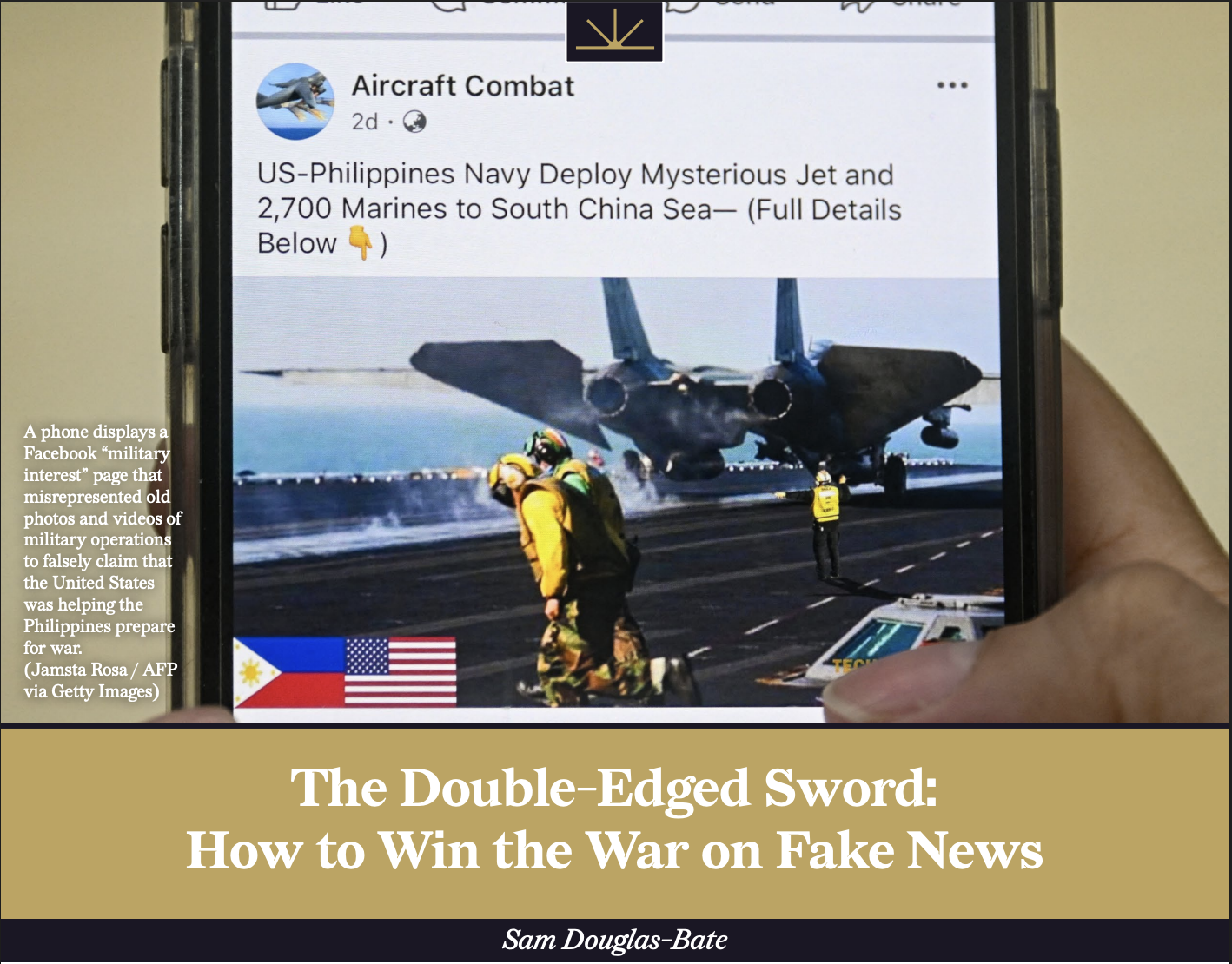
The Double-Edged Sword: New Technologies to Win the War on Fake News
Misinformation and disinformation are among the United States’ most pressing concerns. Technologically sophisticated foreign actors, such as Russia and the People’s Republic of China, use influence campaigns as a disruptive tool to amplify discontent, shape election results, and blur the lines between fact and fiction. While emerging technologies like artificial intelligence and advanced social media algorithms offer significant benefits to society, they are also frequently exploited for disinformation, making careful oversight and policy reform essential to safeguarding U.S national security. Social media accounts and bot networks rapidly disseminate fake news to influence American perceptions of domestic and foreign policy events. Additionally, deepfakes and generative AI can produce highly realistic images and videos that many Americans struggle to recognize as fake. These efforts combine to assist the foreign policy goals of malign actors and pose destabilizing risks to American society. Technology’s role in foreign influence campaigns This paper examines the dual role of technology in both spreading and countering fake news. It also discusses China’s use of these technologies to influence events in the United States such as the COVID-19 pandemic and federal, state, and local elections. While China’s objectives in spreading fake news may not always be clear, countering its efforts to manipulate U.S social media platforms to influence American perceptions of domestic and foreign affairs remains essential. Additionally, the paper discusses the challenges U.S. companies face in addressing this issue while navigating partisan divides over censorship and inflammatory messaging. The popularity and influence of platforms like TikTok, with over 170 million American users, show the difficulty the government has in striking a balance between highlighting foreign influence to the public, bolstering national security and protecting freedom of speech. Existing laws, such as the Foreign Agents Registration Act can be utilized to hold foreign state-owned companies, media, and individuals responsible for acting as agents of foreign nations to advance their geopolitical goals. The paper ends with thirteen recommendations for U.S. policymakers to combat misinformation and disinformation as well as three detailed ones summarized below. Policy Recommendations in the report include: - A State-Funded Transparency Panel: Establishing an information transparency panel to investigate the most severe cases of fake news propagation, publish findings, and clarify information with linked sources. - A Government-Led Awareness Campaign: The U.S. government could bring together divergent strands into a single aligned campaign encouraging the public to do their own research. Alternatively, a new remit could be given to the FCC as part of its broader responsibility for strengthening the nation’s communications infrastructure. - Support for New Platforms: Prioritize new entrants that set tackling of fake news as their core mission.
Future Throughts Blog
A number of short blogs and easily readable think pieces published on the ForgeFront website.
Is your SME fit for the future?
In this blog for the Small Business Research and Enterprise Centre, Sam argues that small businesses use futures and foresight far less than large firms and government do, and that the ones who take it up gain an edge. He explains foresight as thinking about several possible futures to make better decisions today, using methods such as scenarios, backcasting and roadmapping. He draws on Shell's use of scenarios before the 1973 oil shock, and on research showing that firms with mature foresight are 33% more profitable than average. He ends with three practical steps: start small with the UK Government Futures Toolkit, train staff, and bring in professional futurists when needed.
Speaking Topics
Global supply chain shocks: how your organisation can meet the challenge of our turbulent world
Drawing upon his work for the UK's trade department and Cabinet Office, Sam shows how organisations can prepare for the next shock to the goods and services they rely on. For the Government Office for Science, his team put numbers on four scenarios for what global supply chains could look like in 2040. For the trade department, Sam built an index that ranks overseas markets for UK exporters, drawing on interviews with industry leaders in 14 markets. McKinsey found that firms can expect a disruption of a month or more every 3.7 years, and that over a decade these cost almost 45% of a year's profits. In 2025 a cyber attack stopped production at Jaguar Land Rover's UK plants for about five weeks. The Cyber Monitoring Centre put the cost at £1.9 billion across more than 5,000 organisations, likely the most economically damaging cyber event in UK history. Sam shows leaders how to find the weak points in their own supply chains, and which early warnings should trigger action.
The Unknown Unknowns: how to spot the trends you have missed
Drawing upon his work on sensitive issues at the heart of UK Government, in both the UK Foreign Office and Cabinet Office, Sam shows how to find the trends most organisations notice too late. In the Cabinet Office he led teams in the Priority Projects Unit, which takes on government's most complex futures and policy problems (so-called ‘wicked problems’). For the Foreign Office's flagship horizon scan, his team's 15 wild cards for 2024 included a new war between old rivals such as Israel and Iran. Six months later Iran launched its first direct attack on Israel, and in June 2025 Israel bombed Iran's nuclear sites. The next shock to your market may come from another industry. In a 2026 study, American households using weight-loss drugs such as Ozempic cut grocery spending by 5.3% within six months, and spending on savoury snacks by 10%. Sam shows teams how to scan beyond their own sector and judge which weak signals deserve action.
The Future Is a Skill: how any organisation can learn foresight
Drawing upon his work leading one of the UK's most influential futures and foresight companies, Sam shows that foresight is a skill any team can learn, practise and measure. A seven-year study of European firms found that those best prepared for the future were a third more profitable than average. They also grew their market value three times as fast. Sam designed FORGE, a free online assessment that places any organisation on a five-level scale of foresight maturity, from 'Flux' to 'Forge'. At RNIB, his team created futures exercises that blind and partially sighted people could use in full. ForgeFront has also built foresight skills at DAERA in Northern Ireland and at Sport England, and is designing a programme for The National Lottery Community Fund. Sam shows you where it sits on that scale today, and the habits that can move you up a level.
How to set probability-based decision making points for your leadership team
Drawing upon his work delivering probability-based forecasts for decision makers, and his partnership with US superforecasting firm Good Judgment Inc, Sam shows you how to set decision-making thresholds for your leadership team, such as 'if the probability of X exceeds Y, do Z'. In 1961 America's military chiefs told President Kennedy that the plan to invade Cuba at the Bay of Pigs had a 'fair chance' of success. The officer who wrote those words later said he meant about 25%, but Kennedy took them as encouragement, and the invasion failed within three days. Sam's ‘futures x forecasting’ method joins futures techniques with numerical forecasts, and earned ForgeFront and Good Judgment recognition from the Association of Professional Futurists in 2025. This method will also feature in the next edition of the Millennium Project's Futures Research Methodology, a standard reference for the field. The skill is quick to learn: in tournaments that the US intelligence community sponsored, less than an hour of probability training made forecasters 6 to 11% more accurate. Sam helps leadership teams agree, before a crisis, the odds at which they will act, so nobody reads a one-in-four chance as good odds.
Synthetic biology: the general purpose technology that will change everything
Drawing upon his work delivering a seminal report for the UK's technology department, and as a trusted supplier to the deep-tech social enterprise the Centre for Process Innovation, Sam explains why engineering biology could change how we make almost everything. By 2075 a hospital patient might receive lab-grown blood, a kidney from a gene-edited pig and a one-off gene-editing treatment for an inherited disease. Each has already happened: Britain trialled lab-grown blood in 2022 and approved the world's first CRISPR treatment in 2023, and in 2025 an American lived a record 271 days with a pig kidney. Sam led OCHRE, a study of where Britain should partner abroad in engineering biology, from American investors to German and Japanese factories. McKinsey estimates that biology could in principle make as much as 60% of the physical inputs to the global economy. The applications it identified could have a direct economic impact of up to $4 trillion a year within 20 years. Sam explains what this means for businesses far beyond medicine, from food and chemicals to materials.
Climate change: what do we not know about the future of our warming planet?
Drawing upon his work as a lead climate adviser for the European Union, and work leading projects for Defra, DAERA and Environmental Standards Scotland, Sam explores what scientists still do not know about our warming planet. In the European Parliament he helped negotiate laws that set binding emissions targets for every EU country and CO2 limits for new cars and vans. Among the biggest unknowns are tipping points: thresholds beyond which change in part of the climate keeps going on its own. In October 2025 more than 100 scientists reported that warm-water coral reefs had already passed theirs. They warned that the Atlantic current that keeps Britain mild could fail below 2°C of warming. After floods, heat, drought and disease hit cocoa farms in West Africa, cocoa reached a record $12,565 a tonne in December 2024, pushing up the price of chocolate. Sam shows leaders which tipping points to watch, and how to build plans that hold up if the climate shifts faster than expected.
The War on Fake News: how technology turbo-charges disinformation, and how to fight back
Online, information is guilty until proven innocent. Drawing on his work with one of the USA's most prominent think tanks, Sam shows how artificial intelligence has made fake news cheaper to produce and harder to spot. His report for Washington's New Lines Institute, 'The Double-Edged Sword', explains how the tools that create fakes can also catch them. He has since taken the argument to the Disinformation Wars podcast and to a public lecture at the Bath Royal Literary and Scientific Institution. In early 2024 a finance worker at the engineering firm Arup joined a video call with the company's chief financial officer and several colleagues. On their instructions, he sent HK$200 million (about £20 million) to five bank accounts in 15 transfers. But everyone else on the call was a deepfake. Sam sets out the tools that expose fakes and the habits that protect staff.
The Geopolitics of Technology: China, the West and the tech decisions that will shape the next decade
Drawing upon a landmark internal report for the UK's Foreign Office, Sam explains how the contest between China and the West will shape the technology choices of every business. When China joined the World Trade Organization in 2001, many in the West hoped trade would make it more open. Chinese factories went on to supply the world, and economists estimate the competition cost the United States up to 2.4 million jobs between 1999 and 2011. China now makes more manufactured goods than the next eight countries combined. His Foreign Office report tracked the rise of BRICS, which has doubled to 10 members since 2024 and now covers almost half the world's people. When China restricted exports of rare earth magnets in April 2025, Ford had to pause production of its Explorer in Chicago within weeks. Sam helps leaders understand these fragile supply chains, which suppliers, markets and technologies carry the most risk, and what to do before the next export ban or tariff.
Media Appearances
How tech is turbo-charging disinformation
In this episode, host Ilan Berman speaks with Sam Douglas-Bate of British futures consultancy ForgeFront about how advances in technology are assisting the proliferation of “fake news” and disinformation - and what Western governments can do about it.
The Double-Edged Sword: How to Win the War on Fake News
Presentation at the Bath Royal Literary and Scientific Institution (BRLSI) in which I examine the pervasive challenge of fake news, encompassing both misinformation and disinformation, and its significant impact on the modern information landscape.
Former Homeland Secretary Michael Chertoff and Others on China and U.S. Tech Priorities
Panel event in which I discussed the technologies behind the rise in online mis- and disinformation.
Feedback
"I have worked with Sam a couple of times and I am always impressed at how rapidly he is able to get on top of complex situations and come up with innovative solutions. Sam's is adept at building trusted relationships across a broad range of stakeholders and he's a genuine team player."
Rachel Seddon
"Sam played a key role in development of the Veterans Strategy Action Plan. His stakeholder engagement and relationship building across government and with external partners was impressive. He had a real delivery focus, was an effective self- starter and showed great initiative in taking forward his projects. Sam was also a strong team played and built collaborative ways of working with colleagues. I could trust him to get on with things and deliver, as well as provide strategic input with impact. It was great to have him in the team."
Jessie Owen
"Sam played an instrumental part in helping bring together the revised strategy for GDS, in particular bringing clarity to our Service Transformation offer. I really enjoyed working with Sam, as did many of my colleagues!"
Abisola Fatokun
"Sam is a steadying hand in an industry that's at an early stage and is a somewhat turbulent environment. Ever since Sam joined the team at Nativz Gaming his strategic insight, leadership and project management skills from the public sector have been invaluable in guiding how we are positioning and building our business in esports and gaming."
Kurt Pittman
"Sam was a first class policy adviser for the ECR Group in the European Parliament who made a substantial contribution in a relatively short space of time. He worked on issues on the agenda of the Committee on Regional Development and the Committee on the Environment, Public Health and Food Safety. Sam was highly regarded by the Members of the European Parliament he advised. He quickly mastered his brief and was an asset to the team, reliably delivering high quality work. As a loyal and supportive team player, Sam was greatly appreciated by his colleagues in the ECR Group secretariat."
Stephen Woodard, OBE
"Sam worked with me as part of the MHP's support for Zurich Insurance. He was an important member of the team, who was knowledgeable, hardworking, and with lots of innovative and valuable ideas."
David Swaden
"Sam was an enthusiastic and resilient member of the strategy team at GDS. He helped think through potential models for the advisory arm of the service to better work with other departments and roll out government platforms. His work on setting up the Advisory Board has been very helpful in ensuring GDS is plugged into the right industry and international networks."
Giulia Matrigiani
"I had the pleasure of working with Sam during his time at Engine MHP. He fully understood our account and the priorities/issues of the sector and he took great care to provide strategic insights that would make a difference. Sam was equally adept at delivering in-depth research, a campaign plan or quickly responding to last minute requests - and each was done in a friendly and professional manner."
Vicki Locke
"TSA worked with MHP for many years and Sam was an integral part of the success of the relationship. He always provided excellent attention to detail and has the ability to listen, absorb and then always provide us with such useful information that we could then share quickly with the membership. Sam's genuine warmth always shone through, allied with a clear understanding of what we needed and was always on the alert for developments that were particularly relevant to the association."
Rachel Tyrrell
"I worked with Sam on a number of different accounts during our time at Engine MHP. He was always positive and proactive, managing his demanding workload with professionalism. He took a genuine interest in all our clients and always delivered high quality well thought out work."
Tas Bhanji
"Sam is a top tier policy leader. He led teams on a number of accounts and projects at MHP which delivered demonstrably positive change for clients. He takes an outcomes focused approach, is an excellent communicator and a natural relationship-builder and he really does go the ‘extra mile’!"
James Gurling, OBE
"Sam and the team at ForgeFront are an invaluable port-of-call when I need policy advice. They have a real understanding of the policy formation process and key players, but uniquely combine this with project delivery skills and horizon scanning expertise. For me, ForgeFront is a consultancy offering something unique to the market. Highly recommend."
Luke Gibson
"Sam closely understands European lawmaking and the complex political environment in which the EU operates. As a political group advisor, Sam was instrumental in setting up the Parliament’s Data Harmonization Working Group, playing a lead role in coordinating work on harmonising safety data between the European Food Safety Authority (EFSA), the European Chemicals Agency (ECHA), and the European Medicines Agency (EMA) under the direction of then EP ECHA liaison, Julie Girling MEP. Sam’s an outstanding public policy professional—skilled, effective, and easy to work with. I would recommend him without hesitation."
Russell Darke
"Sam and the Forgefront team were incredibly helpful to the RNIB as we embarked on a major strategic redesign. The organisation had never used futures techniques before, and the team's approach to embedding lasting skills within the RNIB means that we continue to develop and evolve our capability. The real-world application of the foresights was the major takeaway, forcing clarity in our thinking for the near-term, but with the added contextualization of future scenarios. Our emergent strategy will be much stronger as a result. The Forgefront team were a delight to work with and we would wholeheartedly recommend."
Daniel Fisher
Enquire about booking